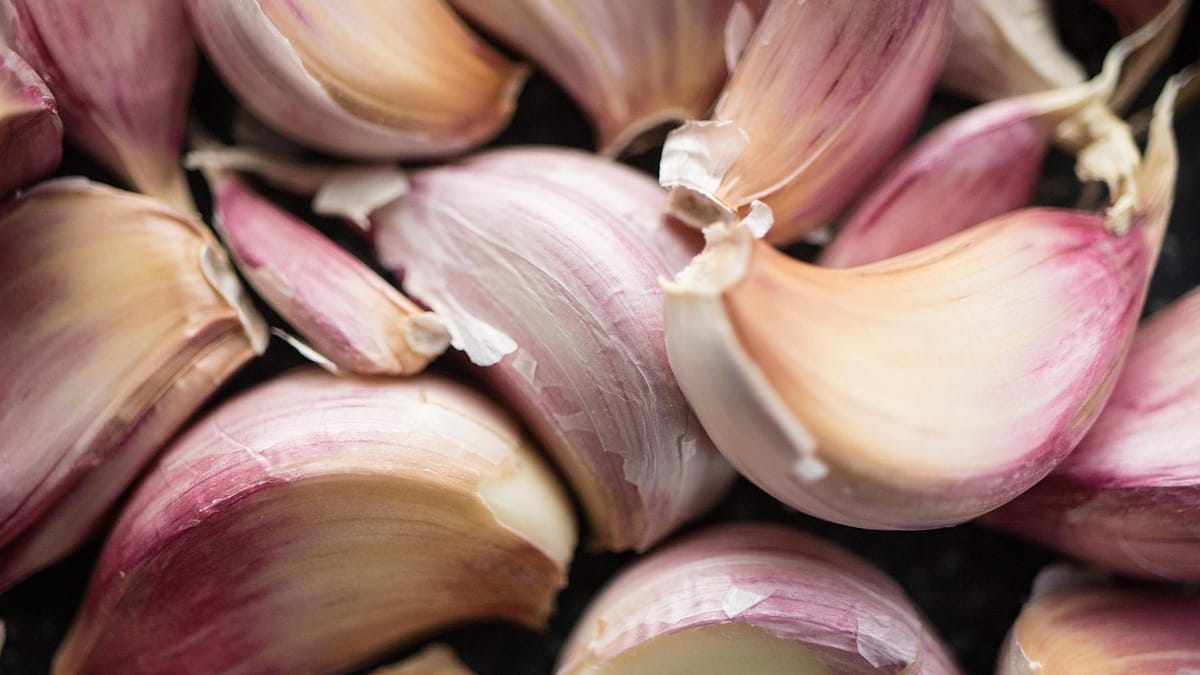
You have your garlic bulbs on the table and a free bed in the vegetable garden, and you are wondering whether to put it all in the ground now. Waiting until the end of winter seems safer, but you have heard that garlic planted early does better. The answer depends mostly on one thing: what happens to your soil when it rains for a long time.
Look at your soil before the calendar
Garlic is hardy and takes frost in its stride. What kills it is standing water around the clove for weeks on end. In cold, waterlogged soil, the clove softens and then rots, and you only find out in spring, looking at a row where nothing comes up.
Do a simple test after heavy rain. Dig a hole one spade deep where you plan to plant, and come back to look at it the next day. If water is still sitting in it, or if the soil sticks to your boots like dough, your soil is heavy. If the water has gone and the soil crumbles, it drains well.
Plant in autumn if the soil drains well
In light, sandy or stony soil, plant in autumn without hesitation. The clove has time to make roots while the soil still holds a little warmth. It gets through winter quietly, then starts growing again as soon as the days lengthen. It is the simplest choice, and the one that gives garlic the longest growing season.
The same advice applies in regions with mild winters, as long as the soil does not stay sodden. There, rain matters more than frost: spot the hollows in the garden where water collects and plant somewhere else.
In heavy soil, plant on a mound or wait until the end of winter
Clay soil does not force you to give up autumn planting, provided you raise the garlic up. Build a mound or a raised bed: the soil drains away at the sides, and the clove stays dry even when the path next to it is muddy. Mix sand or well-rotted compost into the soil of the mound to lighten it, then plant as you would in light soil.
If you have neither the time nor the space for a mound, be patient. Keep your cloves cool and dry, somewhere airy, and plant at the end of winter, once the soil has drained and no longer sticks to your tools. The season will be shorter, but you will not lose half the row. Do the same if your winter swings between hard frost and wet, mild spells: the thaw then turns the bed into a sponge.
Simple steps that prevent rotten cloves
A failed row is just as often down to dubious planting stock or overly rich soil as to the wrong planting date.
- Use cloves sold for planting. Garlic from the supermarket may have been treated to stop it sprouting and is not guaranteed to be disease-free.
- Split the bulbs into cloves just before planting, without peeling them, and keep the biggest ones. Discard any that are soft, spotted or mouldy.
- Plant each clove pointed end up, leaving 10 to 12 cm between cloves in the row and 30 cm between rows.
- Cover with fine soil and firm it lightly with the flat of your hand.
- Do not add any fresh manure. Soil that was improved for the previous crop is more than enough.
- Do not water in winter, the rain takes care of that.
- Label the row, so you know where it is if the shoots are slow to appear.
A light mulch can protect the surface, but in heavy soil, avoid a thick layer that holds moisture against the cloves.
Choose garlic's neighbours carefully
Some companions are recommended by agricultural advisory services: celery, cucumber, lettuce and strawberries. Strawberries are handy too, as they are already in the ground when you plant garlic in autumn.
Other pairings are simply traditional, such as beetroot, carrots or chard. Nothing is proven, but nothing is harmful either. For tomatoes and potatoes, sources contradict each other, so do not count on any particular effect.
As for neighbours to avoid, tradition advises against legumes such as beans and broad beans, as well as peas, on which opinions differ. It also rules out other alliums (leeks, onions, shallots), asparagus and spinach, and sometimes hearting cabbage, again with conflicting sources. The soundest advice is still not to group garlic with its cousins, onions and leeks, so that the same problems are not concentrated in one place.
Prepare the bed now
Do the hole test after the next heavy rain, it settles the question. If the water drains away, weed, loosen the soil and plant this autumn. If it stands, build your mound straight away so that it has time to settle before planting, or store your cloves somewhere dry until the end of winter.
To find out when to plant where you live, check the table of dates below the article, calculated for the climates in your country. Semiterra also gives sowing and planting dates for your local area, which helps you avoid planting too early or too late for your altitude.